Mastering Polishing Techniques: An Artisanal Guide to Fine Jewellery Care

Your high-polish platinum ring might be losing a fraction of its soul every time it meets an abrasive cloth. You likely cherish the exquisite brilliance of your bespoke pieces, yet you worry that removing a deep scratch might mean sacrificing the precious metal weight of your family legacy. It's a valid concern for any collector in Singapore who values both the aesthetic and the structural integrity of their fine jewellery. Understanding the right polishing techniques is essential to ensure your treasures remain as vibrant as the day they were first commissioned.
We've seen how a misplaced buff can dull the fire of a hand-selected gemstone or wear down the intricate details of a custom setting. In this artisanal guide, we'll share the professional methods our master jewellers use to restore brilliance while preserving the longevity of your most cherished pieces. You'll learn which techniques are safe for specific gemstones and how to maintain that unparalleled glow between your visits to our workshop. We're moving beyond simple cleaning to explore the delicate balance of professional restoration and daily care.
The Science of Shine: Understanding Professional Polishing Techniques
Achieving a mirror-like finish on fine jewellery requires more than a simple wipe; it's a meticulous craft. Professional polishing techniques involve a multi-stage abrasive process designed to level the metal's surface at a microscopic level. When the surface is perfectly flat, light reflects uniformly, creating that signature brilliance we associate with high-end luxury.
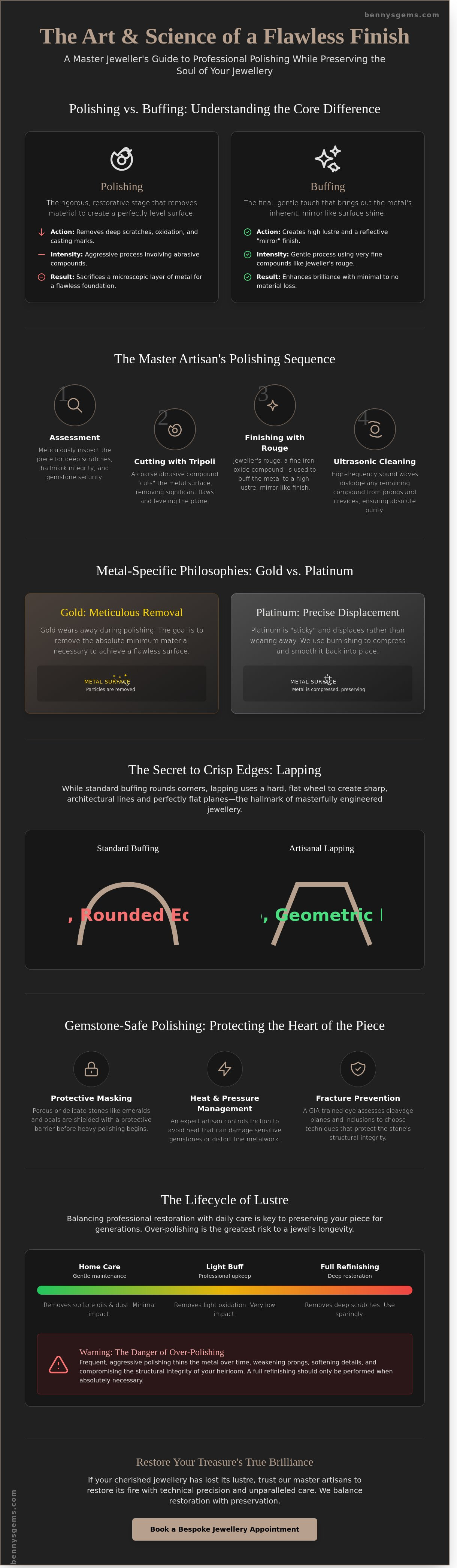
Many people confuse polishing with buffing. Polishing is the rigorous stage where we remove deeper scratches and layers of heavy oxidation. Buffing is the final, gentler touch that brings out the surface shine. Understanding The Science of Metal Polishing helps us appreciate why each step is vital for the metal's integrity. We focus heavily on material removal. A master artisan's goal is to achieve a flawless finish while losing as little precious metal as possible. Excessive abrasion can thin out a ring's shank or soften the sharp edges of a setting over time.
Friction and heat are essential tools in this process. They soften the metal slightly during the transition, yet if mismanaged, they can distort the delicate properties of gold or platinum. This balance is why professional expertise is non-negotiable for high-value pieces.
Mechanical vs. Hand Polishing: The Artisan's Choice
Mechanical polishing uses high-speed lathes. These machines are perfect for broad surfaces and the initial roughing stages. They provide the power needed to smooth out casting marks quickly and efficiently. However, machines have limits. They can't reach the tiny crevices of a complex floral setting or the intricate underside of a pavé bridge.
Hand-polishing is where the artisan's soul enters the piece. It's a slow, deliberate method using handheld tools and fine threads to reach every hidden angle. This level of detail is the hallmark of a high-quality bespoke jewellery appointment. In Singapore's luxury market, this human touch distinguishes a mass-produced item from a true heritage piece that's built to last for generations.
Artisanal Methods for Gold, Platinum, and Gemstones
Refining gold and platinum requires a master's touch and a disciplined sequence of polishing techniques. The process begins with Tripoli, a relatively coarse abrasive compound used to "cut" the metal and remove surface scratches or casting marks. Once the surface is uniform, we transition to jeweler's rouge. This fine, iron-oxide-based compound creates the mirror-like, high-lustre finish that defines luxury. Platinum demands a different philosophy. It's a "sticky" metal that doesn't wear away like gold; instead, it displaces. We utilize burnishing, where we use highly polished steel or tungsten tools to compress and smooth the metal surface rather than cutting it down. This ensures the piece retains its structural weight over decades of wear.
Preserving the hallmark is a priority during every stage. These stamps are the record of a piece's purity and heritage, especially within the regulated Singapore market. We work meticulously around these delicate markings to ensure they remain legible for future generations. After the final buffing, the jewelry undergoes an ultrasonic cleaning. This process uses high-frequency sound waves in a specialized solution to shake loose any compound residue trapped in tight prongs or under the intricate gallery of the setting.
Lapping: The Secret to Crisp Edges and Flat Surfaces
Lapping provides the architectural precision found in bespoke engagement rings. While a standard soft buffing wheel tends to round off corners, a hard, flat lap creates sharp lines and perfectly flat planes. This contrast between light and shadow gives a ring its professional, high-end character. It's the difference between a piece that looks handmade and one that looks masterfully engineered with crisp, geometric integrity.
Gemstone-Safe Polishing: Protecting the Heart of the Piece
Working with rare gemstones adds a layer of complexity. Porous stones like emeralds or delicate opals are sensitive to heat and pressure. We often use masking techniques, applying protective barriers to the gems before the heavy polishing techniques begin. Understanding The Science of Shine is vital here. A GIA-trained eye assesses the stone's cleavage planes and inclusions to prevent fractures during the process. If your cherished jewelry has lost its lustre, you might book a bespoke jewellery appointment to ensure it's restored with technical precision and artisanal care.
The Lifecycle of Lustre: Professional Restoration vs. Home Care
Many collectors worry that frequent maintenance might wear down their precious pieces. It's a valid concern. Over-polishing occurs when aggressive polishing techniques are applied too often, gradually thinning the metal. Every time a piece undergoes restoration, a microscopic layer of metal is removed. To protect the integrity of your jewellery, we distinguish between a light buff and a full refinishing. A light buff removes surface oxidation without compromising the metal's volume, making it ideal for maintaining the character of heirloom pieces. In contrast, a full refinishing is a deeper restorative process reserved for items with visible wear.
For white gold jewellery, the final stage of restoration almost always involves rhodium plating. Because natural white gold has a warm, yellowish undertone, this rare liquid metal coating provides the icy, mirror-like brilliance that Singaporean clients expect. Without this professional step, the metal will eventually lose its crisp, silver-toned aesthetic. Professional intervention ensures that these delicate chemical balances are maintained correctly.
Maintaining Brilliance Between Professional Visits
Daily life in Singapore's humid climate can cause oils and dust to dull your collection. You can safely maintain all rings by using a soft, lint-free microfibre cloth to wipe away fingerprints after each wear. For a deeper home clean, use lukewarm water mixed with a drop of mild, pH-neutral dish soap. Avoid toothpaste at all costs. Its abrasive particles, designed for tooth enamel, act like sandpaper on soft gold and platinum, creating thousands of micro-scratches that eventually kill the metal's natural glow.
When to Consult a Master Jeweller
Simple cleaning can't fix structural issues. If you notice deep nicks or "pitting"-tiny holes in the metal surface-it's time for professional care. These flaws often require advanced polishing techniques like metal laser-filling. This process uses a concentrated beam to melt a tiny wire of matching alloy into the dent, ensuring the repair is invisible to the naked eye. If your jewellery feels rough to the touch or looks cloudy despite cleaning, contact us for a professional assessment. We'll help you decide if your piece needs a gentle refresh or a master artisan's touch to restore its original glory.
Preserving Your Legacy of Lustre
Your fine jewellery deserves more than a passing glow. It requires a meticulous approach to maintenance that respects its artisanal heritage. Mastering professional polishing techniques is about more than aesthetics; it's a commitment to preserving the structural integrity of your gold and platinum pieces for years to come. While gentle home care has its place, the deep brilliance of a gemstone is best revived by those who understand its unique geological properties and delicate vulnerabilities.
Since 1993, Benny's Gems Creations has served as a trusted advisor to Singapore’s most discerning collectors. Our team includes GIA-trained gemologists and proud members of the International Colored Gemstone Association (ICA). We treat every heirloom with the same precision we apply to our own bespoke creations. Trusting your treasures to experts ensures that every facet continues to capture the light exactly as it did on the day you first wore it. We invite you to experience the difference that decades of specialized craftsmanship can make for your collection.
Book a Bespoke Jewellery Appointment for Professional Restoration at our Singapore atelier. Let's ensure your most cherished milestones continue to shine with unparalleled vibrancy and grace.
Frequently Asked Questions
What are the three main stages of jewellery polishing?
Professional jewelry polishing involves three distinct stages: pre-polishing, buffing, and final finishing. First, our master artisans use abrasive compounds to remove deep surface imperfections and scratches. Second, a buffing wheel with Tripoli compound levels the metal surface to create a smooth foundation. Finally, we apply a high-luster rouge to achieve that signature mirror-like brilliance. These refined polishing techniques ensure every bespoke piece reflects light with unparalleled clarity.
Does professional polishing remove a layer of gold or platinum?
Yes, professional polishing removes a microscopic layer of metal, typically less than 0.001mm of gold. Gold is a soft material that wears away under friction during the restoration process. Platinum behaves differently because it's denser; the metal usually displaces rather than disappears entirely. Our craftsmen use precise polishing techniques to minimize metal loss while restoring the vibrant glow of your family heritage pieces.
Can you polish gemstones to remove scratches?
You can certainly polish gemstones to remove surface scratches, though this requires a specialized lapidary rather than a standard jeweler's wheel. Diamonds and sapphires rank 10 and 9 on the Mohs scale, so they require diamond-impregnated pastes for successful restoration. Softer stones like emeralds need extreme care to avoid heat fractures. We recommend a professional assessment to ensure the stone's structural integrity remains intact during the re-polishing process.
How often should I have my engagement ring professionally polished?
You should have your engagement ring professionally polished once every 12 to 18 months. Frequent polishing can thin the prongs over a 10 year period, so it's best to balance professional maintenance with monthly at-home cleaning. In Singapore's humid climate, daily oils and lotions build up quickly on the metal's surface. Bringing your ring to our boutique once a year ensures the setting remains secure while maintaining its exquisite, hand-selected sparkle.